

Gold as Grammar
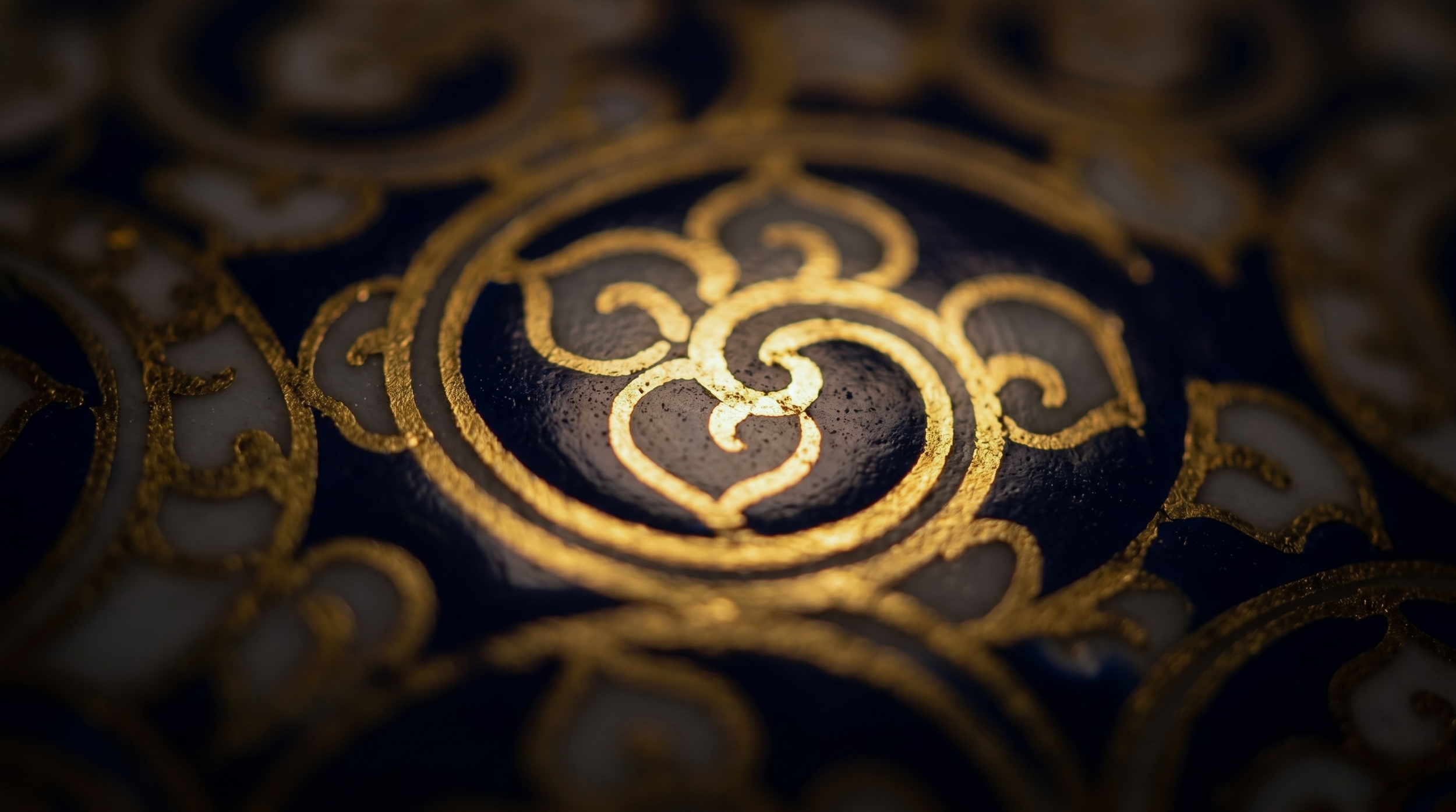
Look at a piece of Benjarong long enough and something clarifies.
The eye roams over the colours, the cobalt, the vermilion, the jade green that reads almost black in certain light. But it settles, eventually, on the lines. The gold lines. Thin as a sentence. Precise as punctuation. Running along the rim of a petal, tracing the spine of a mythical bird, bracketing a field of colour that without them would read as noise.
This is the moment when Benjarong reveals what it is: not a painted object, but a written one.
In traditional Benjarong, the master artisan does not apply gold at the beginning. It arrives last, or nearly last, after the piece has already passed through fire multiple times. The mineral pigments, cobalt for the deep blue, iron oxide for the red, copper compounds for the green, are applied onto the fired glaze and sent back into the kiln. Only when the colours are locked does the gold come.
This sequence is not merely technical. It is philosophical.
Gold fires at a lower temperature than the mineral pigments beneath it. Apply it too early and the kiln destroys it. The artisan must therefore complete the composition before the gold can enter it, they must resolve the colour relationships, the balance of pattern and ground, and only then draw the gold line across the surface of what is already finished.
The gold does not build the sentence. It parses it.
In Western decorative traditions, gold on porcelain typically signals luxury in the most direct sense: gilded rims, gold grounds, gold used as area rather than line. Think of Sèvres at its most maximalist, or the English bone china that covered its surfaces in gold as a demonstration of wealth. The gold there is an assertion. It says: this is expensive.
Benjarong gold does something different. It is almost never used as area. It is almost never used to fill. The gilded line in Benjarong is fine, often barely a millimeter wide, and its job is not to cover but to define. Where the cobalt meets the cream ground, the gold traces the boundary. Where the petal of the lotus curves, the gold follows the curve precisely, turning what might otherwise be a colour relationship into a contour, a fact, an outline.
The distinction matters because it changes what you see when you look. A piece of Benjarong without its gold tracing would still be coloured, but it would lose its distinction.
Every Benjarong motif carries meaning. The lotus, depicted in bud or bloom or seed pod, speaks differently in each state — purity, enlightenment, abundance. The mythical birds of the Thai court tradition are not ornamental figures; they are bearers of specific cultural significance, inherited from centuries of royal commission and Buddhist cosmology.
These are not patterns. They are a vocabulary. And a vocabulary, to be read, requires clarity of form.
The gold line is that clarity. It is what separates a wing from the blue field surrounding it. It is what gives the lotus its distinct petals rather than a blur of colour. Remove the gold and the motif becomes impression. The gold returns it to statement.
This is what we mean when we say grammar. Grammar is not decoration applied to language. Grammar is the structure that makes language mean something rather than merely exist. The gilded line in Benjarong is not applied to the design. It is what makes the design a design.
The artisans who paint Benjarong today, the few who remain, hold this understanding in their hands in a way that is difficult to articulate from the outside. The line must be drawn in a single, confident movement. There is no blending it, no correcting the wobble of an uncertain stroke. The kiln will set what the hand laid down.
This means every gilded line on every piece is a record of a decision made at speed, without the possibility of revision. Multiply that by the hundreds of lines on a single covered jar. Each one the length of a breath held and released.
Most buyers will not consciously register this. But they feel it. The quality of a Benjarong piece reads differently from across a room than it does up close, and differently still when you hold it. What you are responding to, in part, is the accumulated consequence of those decisions — the fact that every line had to be right, because there was no other way.
There is a reason the finest Benjarong commissions have always been associated with occasions of weight: royal gifts, state presentations, the marking of lineage and alliance. The craft's technical demands made it an honest signal. You could not fake a perfectly gilded line. You could not abbreviate the firings. The piece, when it arrived, was evidence of time, mastery, and intention — all three made visible.
That logic has not changed. The gold still comes last. The line is still drawn in a single movement. The kiln still decides.
What has changed is the rarity. The number of artisans capable of this work is small enough that the craft's continuation is genuinely uncertain. Each piece commissioned now is not only an object, it is a record that this is still possible, in this decade, at this level.
The gold line, in that sense, is not only grammar. It is punctuation at the end of something that may not continue indefinitely.
Which is perhaps why it deserves to be read carefully, while there is still time.